
AI, Zero-Clicks & Trust Signals: The New SEO Playbook for 2026
In 2025 and beyond, SEO isn’t just about ranking on page 1 anymore. With the rapid rise of AI-powered search engines and zero-click results, the rules of the game have changed, and marketers need a fresh playbook. At Click Catalyst Media, we believe that mastering this shift isn’t optional; it’s essential for staying relevant, visible, and trusted.
This blog dives deep into how AI, zero-click search, and trust signals are rewriting SEO, and what you can do to thrive in 2026.
What’s Changing: From Clicks to Answers
The Rise of Zero-Click and AI-Driven Search
- A “zero-click search” occurs when a user obtains the information they need directly on the search results page (SERP), without requiring a click.
- Thanks to features like featured snippets, knowledge panels, instant answer boxes, and now AI-generated summaries from tools like Google AI Overviews, more queries are being answered instantly, right on SERPs.
- In 2025, studies report that over half of searches now end without a click.
What this means: the SERP isn’t just a gateway anymore for many; it’s the destination.
Why the Shift Has Accelerated
- AI-powered engines are getting smarter: They don’t just list links; they synthesize information from many sources into a direct, conversational answer.
- Search behavior is changing: Users prefer speed and convenience. When they can get answers instantly, many don’t bother clicking further.
- Mobile, voice, and local queries, which often lend themselves to instant-answer formats, continue to grow, increasing zero-click potential.
What It Means for Traditional SEO
If your SEO strategy is still heavily reliant on “rank high → get clicks → conversions,” you might be in for a surprise.
- Lower Click-Through Rates (CTR): With AI summaries and zero-click formats dominating SERPs, organic CTR for informational queries has dropped dramatically. One report by marketing agency Seer Interactive shows a ~61% drop in organic CTR when AI Overviews appear.
- Traffic doesn’t tell the full story anymore: Even if you rank first, users may never click your link. What counts more now is whether your content (or brand) gets cited, referenced, or included in AI-generated answers.
- Attribution becomes murky: Since many users never reach your site, traditional web analytics can’t capture their paths. That means fewer page views and fewer measured conversions, even if your brand is still resonating.
In short: top rankings alone are no longer enough.
The New SEO Playbook for 2026: AI + Zero-Clicks + Trust
To succeed in this evolving landscape, marketers must adopt a hybrid strategy. Here’s how to reframe your SEO approach for 2026: one that blends traditional SEO with trust-centered, AI-aware tactics.
1. Shift from Click-Chasing to Answer-Ownership
- Embrace Generative Engine Optimization (GEO) / Answer Engine Optimization (AEO). These are strategies designed to get your content included in AI-generated answers, rather than just ranking in conventional SERPs.
- Structure content to be “AI-friendly”: Use clear headings, concise paragraphs, and direct answers. Format your content to match how AI prefers to show information; think bullet lists, tables, and short paragraphs, not long, meandering blog posts.
- Optimize for snippet potential: If a query currently triggers no featured snippet or SERP feature, aim for traditional ranking. If it does, lean into formats optimized for snippets or AI summaries.
2. Build “Trust Signals” Because AI Cares About Credibility
In the age of AI search, trust and authority matter more than ever. AI engines are increasingly selective about which sources they include in their answers. If your site lacks credibility or reveals poor technical hygiene, you’ll get overlooked.
Here’s what to focus on:
- Technical health: Schema markup, valid structured data, clean HTML, fast loading times, and secure site architecture. These make it easier for AI engines to crawl, parse, and understand your content.
- Consistent identity & branding: Maintain a verified, consistent presence across your site and other web properties. Consistent branding and identity help AI ‘recognize’ your authority.
- Evidence-based content: Use credible sources, data, citations, quotes, and clearly referenced stats. AI systems are more likely to pull from sources they deem “trusted.”
- Diverse presence & earned media: Instead of just relying on your own blog, work on getting mentions in high-quality, authoritative third-party sites. External validation helps AI tend to value “earned” sources over self-published content.
3. Rethink SEO Metrics: It’s Not Just Clicks & Pageviews Anymore
Classic KPIs, such as page views, bounce rate, and organic traffic, are losing relevance in a zero-click world. Instead, prioritize:
- Impressions in SERP features: How often does your site or brand get cited in AI summaries, knowledge panels, or featured snippets?
- Brand mentions and share of voice: Are you being referenced as an authority by other publications or platforms?
- Engagement and conversions from alternate touchpoints: For example, direct traffic, newsletter signups, social media interactions, or conversions that don’t originate from organic search clicks.
- SERP real estate occupied: Even if you don’t get the click, being visible in the AI-driven answer can boost brand recall and trust. That counts.
4. Diversify Your Discovery Channels Because SERPs Alone Aren’t Enough
Given the uncertainty of clicks, it’s smart to expand how people find you:
- Social media audience engagement on social senses still matters.
- Newsletters and email campaigns can directly reach their audience, bypassing AI filters entirely.
- Guest posts and collaborations being cited in authoritative third-party content improve your brand’s trust.
- Community & social proof: real user reviews, testimonials, and user-generated content. AI tends to value authentic, user-driven content as a strong signal of trust.
Putting It All Together: A Practical 2026 SEO Playbook
Here’s a step-by-step guide you can use whether you’re running content for your own business or building SEO campaigns for clients.
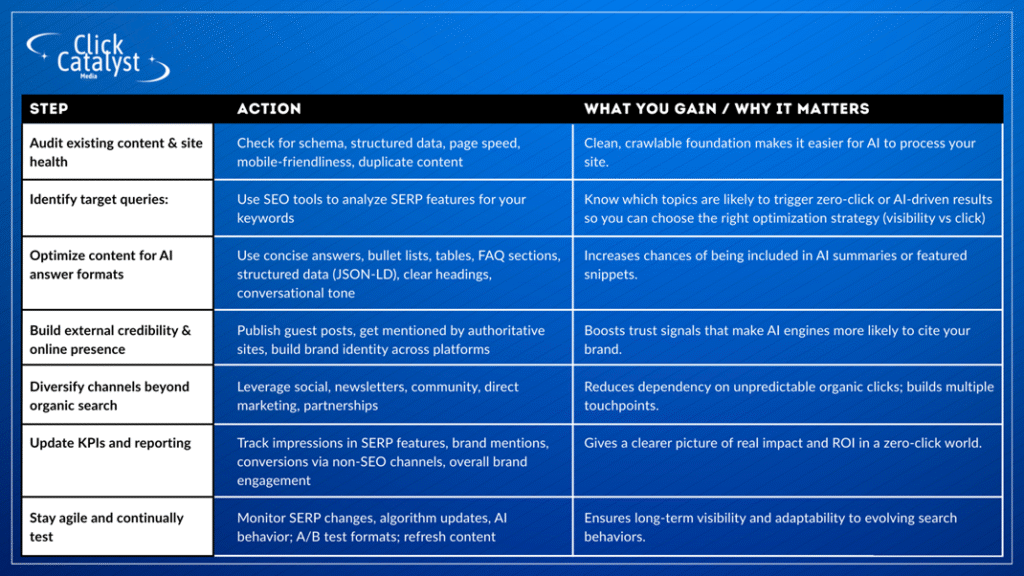
Why This Matters for Click Catalyst Media & Your Clients
At Click Catalyst Media (CCM), our mission has always been to help brands grow with smart, data-driven marketing. The rise of AI-powered, zero-click search doesn’t mean SEO is dead, but it does mean SEO needs an upgrade.
By proactively embracing GEO/AEO, trust signals, and a diversified approach to discovery, we can help our clients stay visible, authoritative, and competitive, even when “search” no longer means “click.”
For agencies and marketers alike, now is the time to test, iterate, and reimagine what SEO means. The first-mover advantage will go to those who recognize that the SERP is no longer a middleman; it’s often the final destination.
Final Thoughts
The Future of SEO Is Trust & Visibility, Not Just Traffic
The SEO landscape is changing rapidly. With AI-powered answer engines, zero-click searches, and evolving user behavior, relying purely on traditional rankings and traffic is increasingly risky. The brands that thrive in 2026 will be the ones that understand the new rules:
- Make content easy for AI to parse and cite.
- Build credibility, authority, and trust beyond backlinks.
- Diversify discovery channels.
- Measure what matters now: visibility, presence, and engagement, not just clicks.
At Click Catalyst Media, we’re excited about the opportunities this new world opens up. If you’re ready to future-proof your SEO and content strategy, we’re ready to help you lead the pack.
Let’s step into 2026 with a smarter playbook.
Call us now at (850) 982-8244 or CLICK HERE for a consultation.